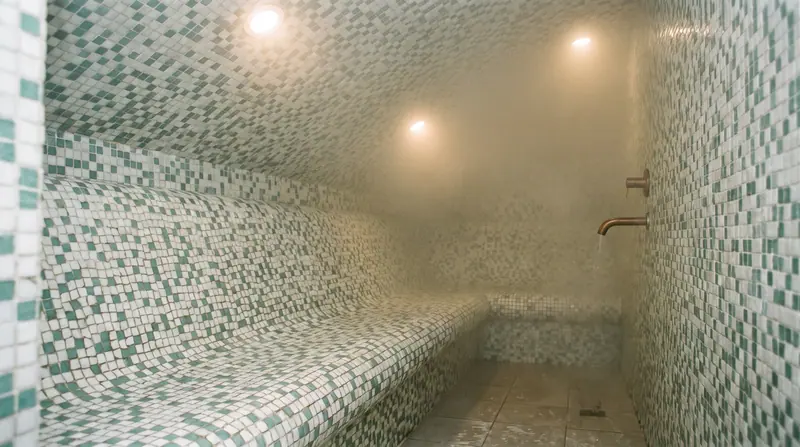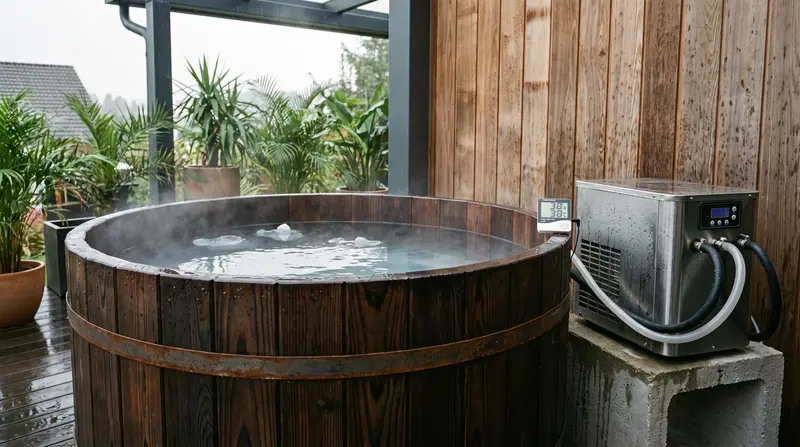
In the wellness business, equipment that dies is a cash register that closes. A sauna that will not heat, a steam room running cold, or an ice bath gone lukewarm is visible to members immediately, and the bad story travels faster than any promotion you run. That is why choosing equipment is not a catalogue exercise; it is a matter of keeping revenue flowing.
The local market has a problem we see repeatedly: cheap components with no warranty network behind them, sellers who disappear once the goods are delivered, and specifications chosen on lowest price rather than actual duty cycle. The result is a facility with a short lifespan — machinery worn out early because it was pushed to work outside its class.
We take a different position: supply only equipment that survives a tropical climate on a commercial schedule, install it to factory standard, and then stay responsible afterward, backed by a domestic spare-parts stock and our own technician team.
What spa equipment do we supply and install?
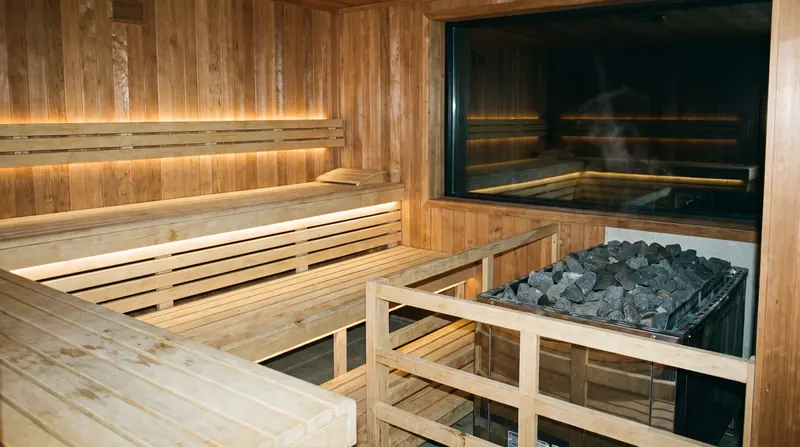
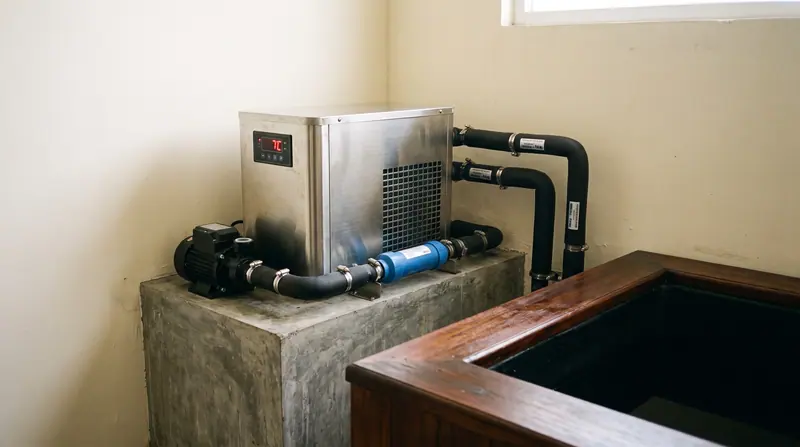
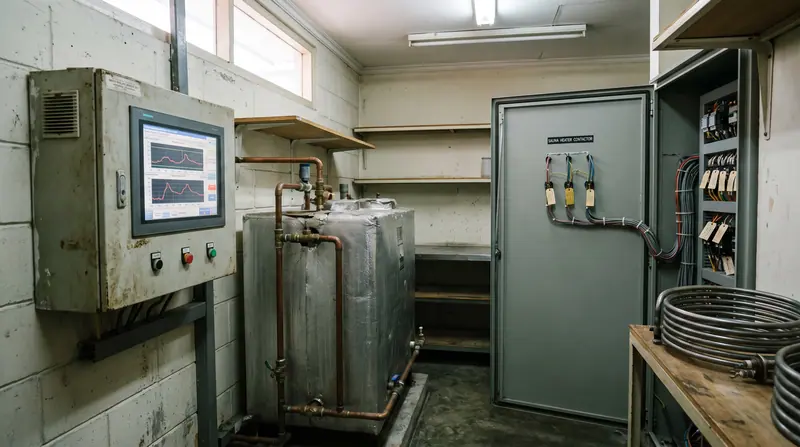
We group what we supply into six main categories, each sourced and specified against your facility’s actual duty cycle rather than a generic catalogue default. Industrial-grade electric sauna heaters — reinforced elements and a large stone load for up to 16 hours of daily operation. Steam generators at 6–9 kW for a steam room, complete with water supply and digital controls. Cold plunge chillers at 1/2–1 HP, along with circulation and filtration — full technical detail sits on our cold plunge chiller page. Control and automation panels that bring every machine onto one screen. Water systems: particle filtration, ozone or UV sanitation, and wet-zone plumbing. And finally, timber accessories — bucket, ladle, stones, thermometer, sand timer — as a ready-to-use set.
Choosing between a full retrofit and a phased upgrade
Not every facility needs everything replaced at once. We often start with the component causing the most visible pain — a heater that has already failed, or a chiller that never quite hits target — and build the rest of the specification around what the electrical and plumbing infrastructure can support today. A phased upgrade lets a facility spread cost across two or three budget cycles while still ending up with a coherent system, rather than mixing an old chiller with a brand-new automated heater that the existing panel cannot actually talk to. We flag compatibility issues like that at the audit stage, before money is committed to a piece of equipment that will not integrate with what is already installed.
What we check before recommending a replacement
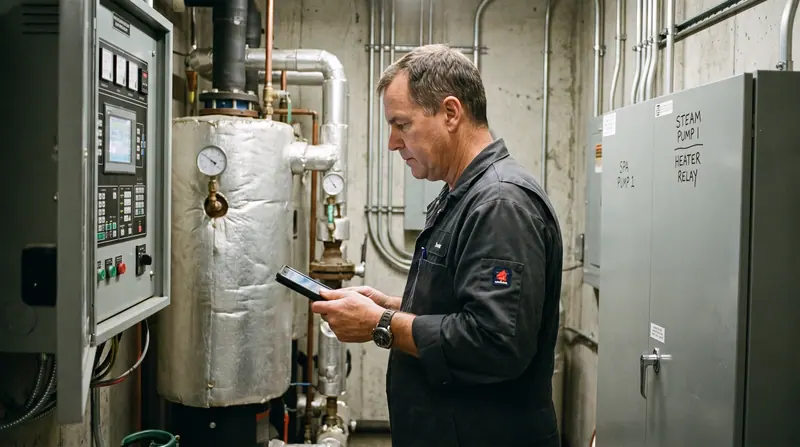
A failing heater is not always a heater problem. Before we quote a replacement, we check the incoming power supply and VA rating, the condition of the existing wiring, water hardness where it affects a steam generator, and whether the room’s insulation is even letting the old unit do its job. Replacing a heater without fixing an undersized electrical supply behind it just moves the failure point a few months down the road. That audit habit is also why our quotes sometimes come back with a smaller number than expected — the equipment was fine, and the real fault sat somewhere else in the system.
How much should you budget for spa equipment in Surabaya?
| Type | Indicative price |
|---|---|
| Full facility equipment package (per project) | from IDR 100 million |
| Harvia heater replacement, 6–9 kW, installed | IDR 15–35 million |
| Cold plunge chiller, 1/2–1 HP | IDR 25–55 million |
| Steam generator | priced to room volume |
| Complete accessory set | IDR 1.5–8 million |
The table is indicative; the firm quote follows a free survey of your facility. We prepare the proposal in two layers — required work and optional upgrades — so you decide by budget priority, not by guesswork.
Why global brands with local backup?
Harvia, Sawo and Tylo are our standard not for prestige but for two measurable reasons: a proven track record under commercial use and a genuine 1–2 year factory warranty available inside Indonesia. But even a good brand without local support carries risk — waiting for a heating element to ship from Europe means a facility closed for weeks. That is exactly why we hold original spare parts in our own domestic warehouse: elements, sensors, contactors and other wear parts are available without an import delay, and our technicians carry them directly to an emergency call. Items we know fail on a predictable schedule are restocked before they run low, rather than reordered only once a facility calls in with a breakdown.
Automation: one panel for the whole zone
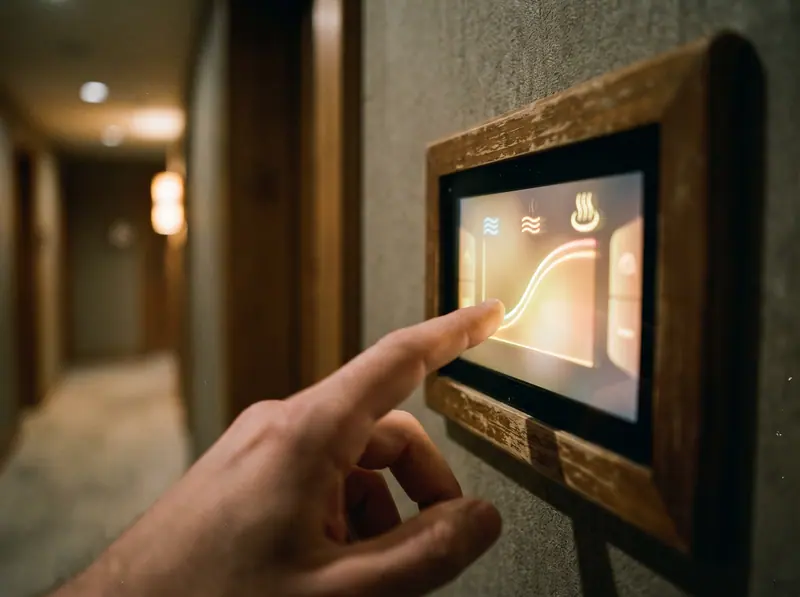
A facility that relies on staff switching machines on one by one is relying on human memory, and memory has gaps. The control system we install brings the heater, the steam generator and the chiller onto a single panel at the front desk: on/off schedules follow operating hours automatically, every room’s temperature is tracked number by number, and a deviation is visible before a member ever notices it. An energy-saving mode lowers consumption during quiet hours and restores full temperature ahead of the busy period — a saving that shows up on the monthly bill without costing the guest experience anything.
Installation by our own team, not a subcontractor
Heavy-duty equipment demands installation of the same standard. Our team calculates the combined electrical load — a three-phase connection for large machine combinations — runs heat-resistant SiHF lines, one breaker per unit, and ELCB protection across every wet-zone circuit, then carries out commissioning: a full-load test, sensor calibration, and an operational run-through with your staff. We support the PLN capacity application where the building does not yet have enough headroom. Before we leave, we train your daily operators and leave a written maintenance guide behind.
Who are our clients?
The most common profile: hotels and spas along the Sidoarjo airport corridor refreshing an ageing thermal zone, corporate facilities inside the industrial estate in Gresik, long-running boutique spas in Darmo whose heater has seen better days, and new gyms in Pakuwon building a recovery zone from zero. For that last group, equipment procurement usually runs as one package alongside construction — the full sequence sits on our contrast therapy wellness zone page. Across every profile, the underlying request is the same: a facility owner who does not want to think about the mechanical side again once the doors open, beyond the routine checks our handover training covers.
How ordering works
- Share your facility’s equipment list with us on WhatsApp.
- A technical manager calls the same day to align on specification.
- Send photos of the plant room and spa area over chat.
- A free site audit verifies the electrical supply and installation routing.
- We prepare a technical schematic and a placement visual.
- The procurement-and-installation quote is signed off in writing.
- A 50% deposit starts ordering the unit from warehouse or factory.
- Commissioning with your team closes the project; the factory warranty runs, and we back our installation with a 2-year guarantee.
Your facility deserves equipment that does not keep you up at night. Send your requirements over WhatsApp — our spa equipment team in Surabaya will reply with a specification and a quote you can actually rely on.