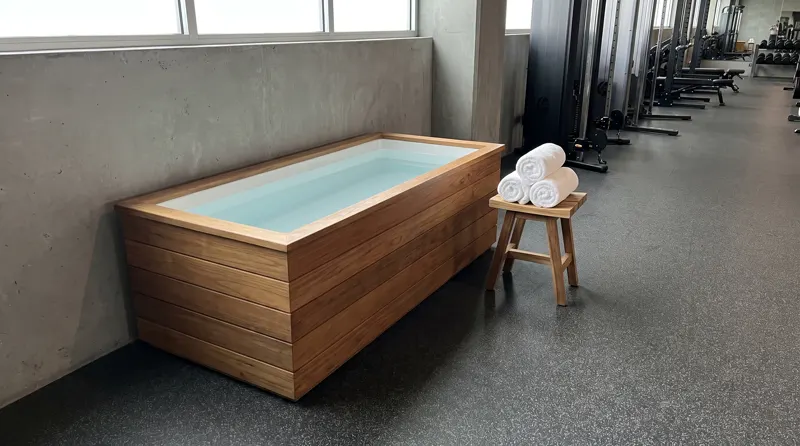
Most people assume an ice bath project starts with the tub. Our experience says the opposite: the tub is just a container, and the whole project’s fate rests on the cooling machine behind it. Even the most expensive timber tub turns into a lukewarm pool if its chiller was sized wrong from the start.
We regularly meet clients who already tried and were disappointed — a local trough or a cheap imported unit bought off a marketplace, only to find the temperature never drops below 18°C, the machine overheats and shuts itself off, or the water turns cloudy within a week. Nearly every one of those cases comes down to the same two mistakes: cooling capacity that does not match the water volume, and no filtration at all.
This page covers how we choose, install and integrate a chiller correctly — whether you are starting from zero or already own the tub.
What does a chiller actually do inside a cold plunge?
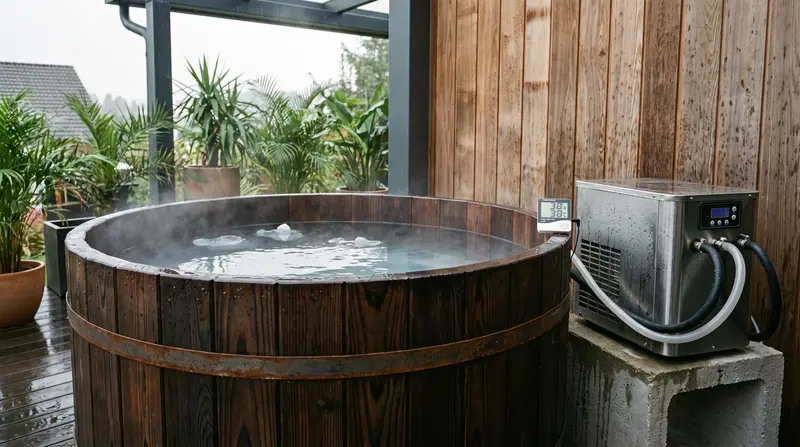
A chiller is a refrigeration system built specifically for water: a pump draws water from the tub through an evaporator, heat is rejected through a condenser, and the water returns to the tub at whatever temperature you have locked on the panel. That cycle runs automatically all day, so the tub is always ready — five in the morning before work, or midnight after a late training session. A thermostat holds the set point; you simply choose a number between 3 and 15°C to match where you are in your cold-adaptation.
Why does Surabaya’s climate demand a stronger chiller?
The hotter the surroundings, the harder a cooling unit has to work, and Surabaya sits at 24–33°C for almost the entire year. Heat creeps into the water through the tub walls, the open surface, and every body that steps in. That is why our sizing always uses the hottest realistic condition rather than an average one: capacity is given a margin, a cover is recommended for idle periods, and the unit itself is placed away from direct sun. A chiller sized for a cooler climate will struggle badly here — the single most common mistake we see on units bought without any consultation at all.
How much does a cold plunge chiller cost in Surabaya?
| Type | Indicative price |
|---|---|
| Chiller, 1/2–1 HP, installed | IDR 25–55 million |
| Wooden cold plunge tub complete with chiller | IDR 45–90 million |
| Full wellness zone (sauna + plunge + jacuzzi) | from IDR 250 million |
| Monthly running cost (power + water) | IDR 300,000–700,000 |
These are indicative figures; a firm quote follows a free survey where the site needs a physical check. If you do not own a tub at all yet, our complete cold plunge package with a timber tub is usually more cost-effective than buying components separately.
Choosing capacity: the science behind 1/2 HP and 1 HP
Four variables drive our recommendation. Water volume: more litres demand more cooling power to bring down. Target temperature: every degree below 10°C asks for extra effort. Frequency of use: every person who gets in deposits body heat into the water. Location: a tub indoors under air conditioning carries a lighter load than one sitting on an open terrace. For home use with a daily session, 1/2 HP is generally enough; for a gym or club where the tub sees a rotating queue all day, we go straight to 1 HP with heavier-duty filtration.
Correct installation: circulation, filtration, sanitation
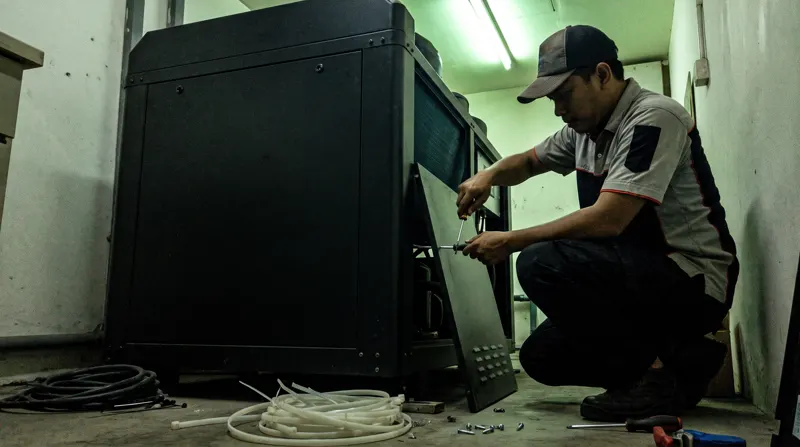
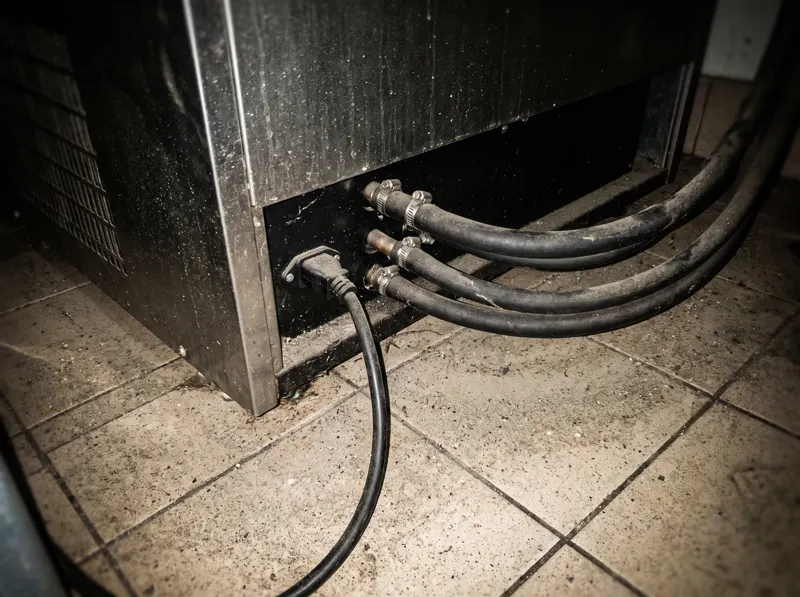
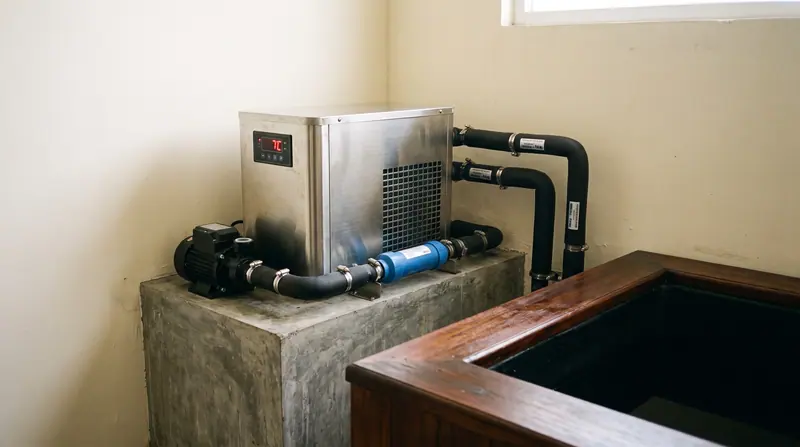
A chiller does not stand alone — it is one part of a water loop that has to be engineered as a whole. We route the suction and return lines for even circulation with no dead spots, add a particle filter ahead of the evaporator so the machine never clogs, and add ozone or UV sanitation so the water stays clear between drain cycles. The unit itself sits in a ventilated area with room to reject heat — a chiller boxed into a tight enclosure will effectively cook itself. On the electrical side, a dedicated circuit with its own breaker and ELCB protection is standard; the power draw is light, but the safety standard around a wet area is not something we scale down.
Power supply and safe placement
A 1/2–1 HP chiller draws roughly 750–1,100 watts of continuous power, a fraction of the 7,700–11,000 VA a sauna heater alone can demand. That means most homes never need to apply for a PLN capacity upgrade just to run a chiller. What we do not compromise on is the circuit itself: a dedicated line with its own breaker and ELCB protection, sized correctly rather than tapped from a nearby socket. The unit also needs airflow to reject the heat it removes from the water — we place it at least 30 cm from a wall, out of direct sun, and never inside a sealed cupboard where its own exhaust would simply recirculate. On noise, a correctly sized chiller running at a sensible setpoint is no louder than a household air conditioning condenser; oversizing a unit, or forcing it to chase an unrealistically low temperature, is what makes a chiller sound strained.
What we find when retrofitting an existing tub
Not every retrofit starts from a timber tub we built ourselves. We regularly fit chillers to fibreglass plunge pools, repurposed IBC tanks, and masonry pools originally built for something else entirely. Each material behaves differently: fibreglass and masonry hold heat longer and need a larger margin on chiller capacity, while a thin-walled IBC tank loses cold faster to the surrounding air and benefits from added insulation around the outside. Before quoting, we ask for the tub’s exact dimensions, wall material, and whether it sits indoors or exposed, because those three facts change the recommended horsepower more than almost anything else.
Chillers for commercial facilities
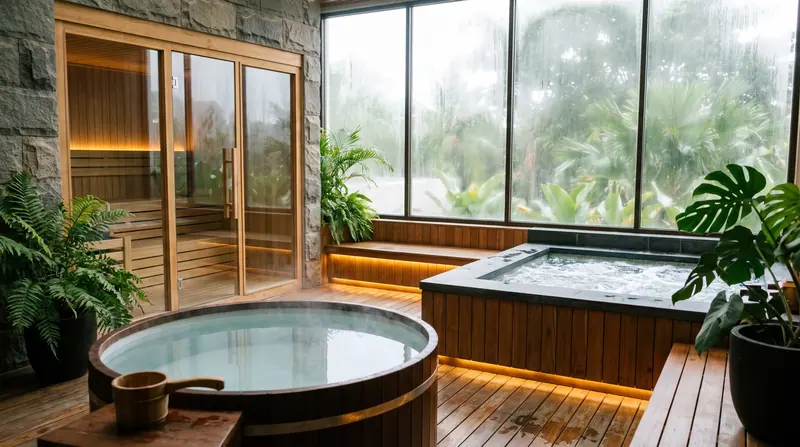
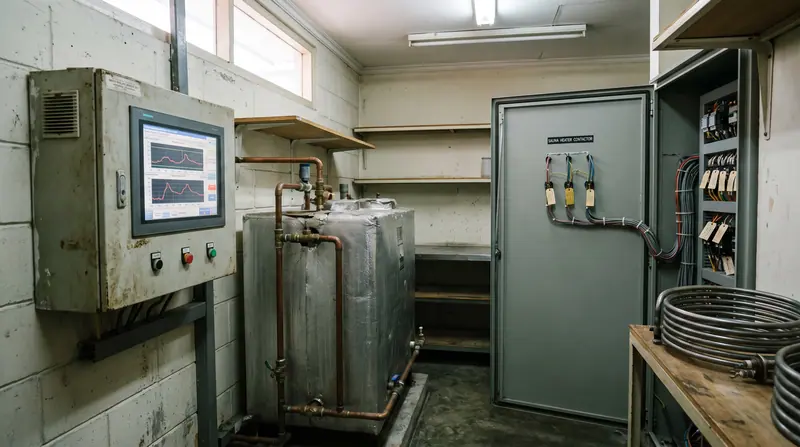
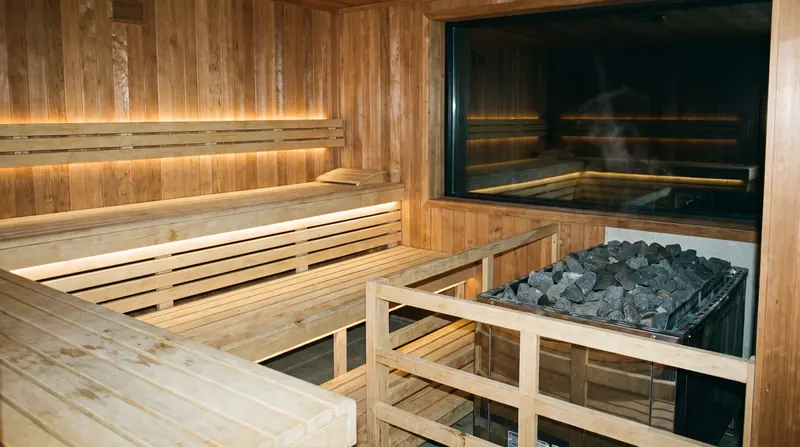
Commercial load is an entirely different league: water absorbs the body heat of dozens of people a day, and the machine barely gets a rest. For gyms, padel clubs and spas we specify units with extra capacity margin, oversized filtration, and a written maintenance schedule for staff. Our commercial clients range from fitness clubs in Pakuwon, to staff facilities inside the industrial estate in Rungkut, to corporate projects in Gresik. If your recovery zone also includes the heat side, a contrast therapy wellness zone brings every machine into one electrical and water plan — tidier than adding equipment piece by piece. Replacement compressors, sensors and filtration cartridges for an ageing unit are available through our spa equipment supply line, so a fault does not mean waiting weeks for an imported part.
How ordering works
- Send your tub’s specification over WhatsApp — volume, material, and target temperature.
- Our technician-manager calls the same day to verify the data.
- Photos of the tub and surrounding area follow over chat.
- A free survey is arranged if the integration needs an on-site pipe check.
- We send an installation schematic and a placement visual.
- A firm quote — unit, installation, filtration — is agreed before anything is ordered.
- Once the 50% deposit lands, the unit is prepared and installed to schedule.
- Handover follows once the target temperature has proven stable; our work carries a 2-year construction warranty, and the machine follows its factory warranty.
Already have a tub that never gets cold, or planning an ice bath from a blank sheet? Send the details over WhatsApp — we will size the right cold plunge chiller for your case in Surabaya, at no cost and with no pressure to buy.