A sauna in tropical climate conditions like Surabaya’s works precisely because it feels nothing like the city’s daily humidity: dry sauna heat runs 70-90°C at only 10-20% humidity, while outdoor air sits at 24-33°C with roughly 80% humidity. One is heat you choose and control; the other is humid discomfort you can’t switch off.
The question we hear most from prospective clients in Surabaya isn’t about price or size — it’s this basic doubt: the city is already hot year-round, so why build a room that makes it hotter still? It’s a fair question, and the answer sits in simple physiology: how the body responds to two very different kinds of heat.
Why dry sauna heat feels nothing like Surabaya’s humidity
Surabaya’s discomfort is high temperature combined with high humidity — a state where sweat can barely evaporate because the surrounding air is already saturated with moisture. The result is a body that feels wrapped in plastic, sweat that clings rather than cools, and a natural cooling process that’s actively blocked. It’s exactly why Surabaya households run air conditioning rather than treating the local weather as some kind of free, healthy sauna.
A dry sauna operates on the opposite principle. The temperature is far higher, 70-90°C, but humidity sits at only 10-20%. At that low humidity, sweat evaporates the instant it reaches the skin, carrying heat away efficiently — which is why that temperature stays tolerable, even pleasant, for someone used to it. And critically, the heat inside a sauna is heat you’ve chosen, timed, and end on your own terms with a cooldown — not humidity that descends on you uncontrolled for hours at a time.
Does the heat mean a sauna in tropical climate Surabaya doesn’t make sense?
The “it’s already hot, why add more heat” argument usually stops the moment someone actually tries it. Self-directed dry heat, closed out with a cooldown in an air-conditioned room, produces exactly the contrast many people in a tropical city are looking for. Most of our Surabaya clients schedule an evening or night session — once the outdoor temperature has eased — so the hot-cold contrast lands at its strongest right as the session ends and they step into cooled air.
A sauna in tropical climate conditions also isn’t competing with the weather outside — it complements it: one is a scheduled ritual of recovery and relaxation, the other is a daily condition you manage with air conditioning. Each has its own place.
Building a sauna to survive high humidity
This is where a sauna in tropical climate conditions is genuinely tested — not on day one, but in year two and three. Surabaya’s humidity, sitting around 80% year-round, is a real threat to wood and electrical systems in a carelessly built room.
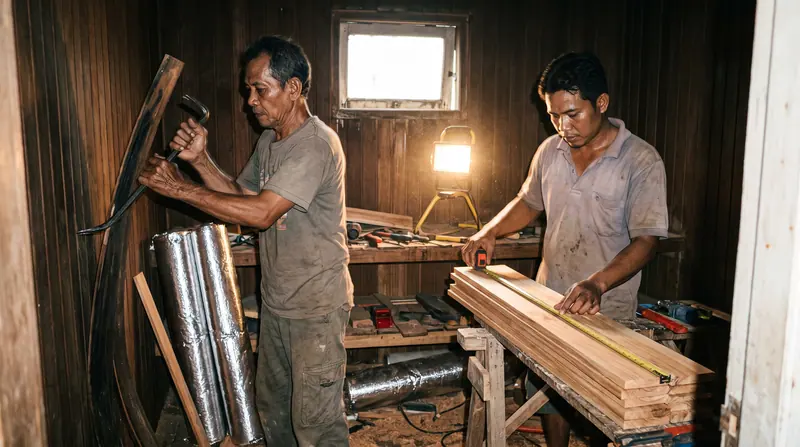
The walls we build are always a five-layer sandwich: a structural panel, 50 mm rockwool insulation, an aluminium foil vapour barrier, a 20 mm air gap, then cedar or thermowood cladding on the inner surface. Skip the foil and the air gap, and even the most expensive sauna will mould and rot within 2-3 years — not because the wood was poor quality, but because moisture from outside worked its way straight through the wall structure.
Intake-and-exhaust ventilation matters just as much: fresh air enters low near the heater, humid air exits diagonally near the top. Without that circulation, the wood never fully dries between sessions, even behind a foil layer.
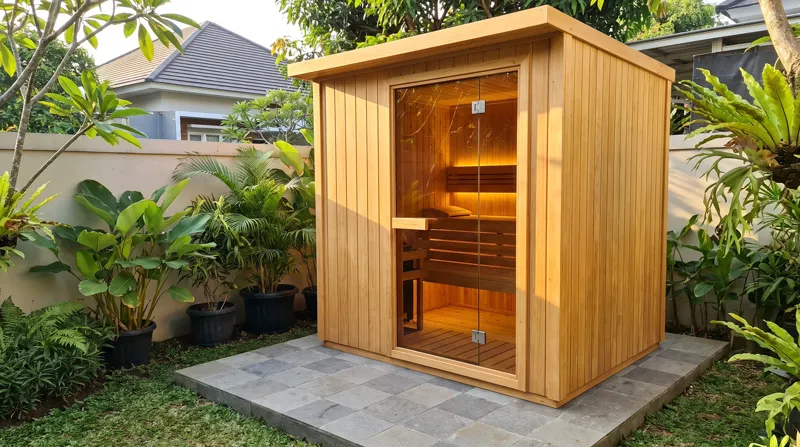
For an outdoor sauna cabin in the garden, there’s one more layer of difficulty: a protective roof against tropical rain and direct UV isn’t an optional extra, it’s a hard requirement. Without proper cover, heavy rain and direct UV exposure will finish off exterior wood in short order.
The part everyone forgets: electronics in tropical humidity
Discussion of a sauna in tropical climate conditions usually stops at wood and ventilation, but Surabaya’s high humidity also puts stress on the sauna’s electrical and electronic components. Digital control panels, temperature sensors and cabling exposed to constant humid air corrode faster than an identical installation would in a drier climate. We position control panels away from direct vapour exposure, use heat-resistant SiHF cable with tightly sealed joints, and choose a heater with a housing designed for high working temperature alongside high ambient humidity.
Power requirements don’t change with climate: a 6-9 kW heater still needs a home wired for 7,700-11,000 VA, and older Surabaya houses still sitting at 2,200-5,500 VA still need a PLN power upgrade. What does change in the tropics is how seriously we treat the separate breaker and ELCB — humidity accelerates cable-insulation wear faster than it would in a drier climate, so those checks happen more often.
Dry sauna vs outdoor tropical air, side by side
| Aspect | Dry sauna | Surabaya outdoor air |
|---|---|---|
| Temperature | 70-90°C | 24-33°C |
| Humidity | 10-20% | around 80% |
| Sweat sensation | Evaporates fast, feels clean | Clings, barely evaporates |
| Control | You set duration and heat | Impossible to control |
| End of exposure | Active cooldown (shower/AC) | No natural end point |
Which sauna format suits Surabaya’s tropical climate
Not every home or need is the same, so the right format should follow your property’s actual conditions:
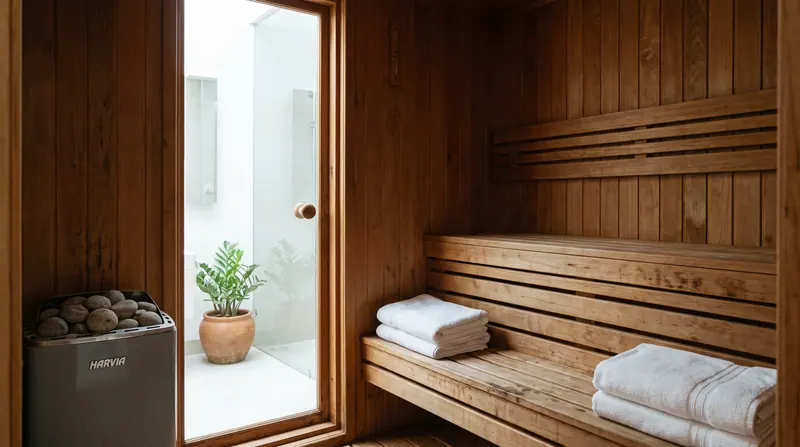
- An indoor sauna next to an air-conditioned room gives the sharpest hot-cold contrast — hot sauna in, cool air straight after. It’s the most requested format for city houses. Full detail is on the home sauna construction page.
- An outdoor cabin in the garden suits a home with generous yard space, provided the protective roof and foundation are built in from day one — not added later once the wood has already started to fail.
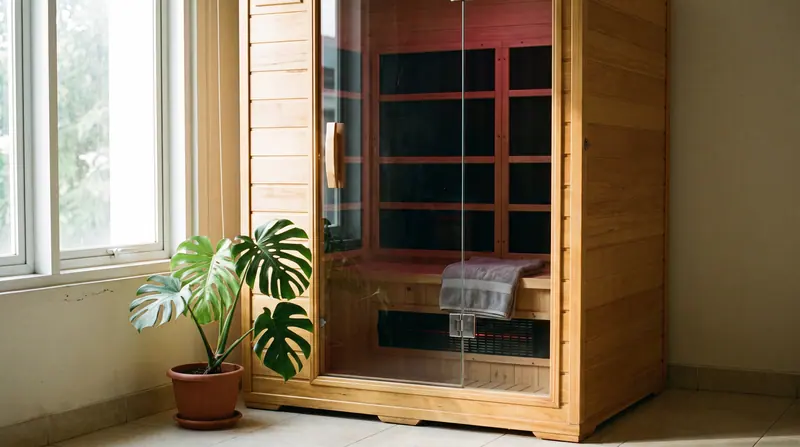
- An infrared cabin is the realistic choice for a home with a limited electrical connection or a compact space like an apartment: it draws only 1.7-2.4 kW, well below a dry sauna’s 6-9 kW, and still delivers controlled heat benefits through a different mechanism — heating the body directly rather than the room air. Full specification is on the infrared sauna page.
Maintenance routine for a sauna in a tropical climate
A properly built sauna in tropical climate conditions still needs a consistent maintenance habit, because outside humidity never stops trying to get in. The simple routine we recommend to every client: open the sauna door and vents after every session so the interior wood dries out fully, avoid sealing the room shut right after use, and check the aluminium foil joints once a year, especially heading into the rainy season when ambient humidity peaks. For an outdoor cabin, check the protective roof and gutters at the start of every rainy season — most of the exterior wood damage we see in renovation work traces back to a blocked gutter or a shifted roof panel the owner never noticed. If you’d rather build some of this yourself, the honest limits of that approach are covered in build your own sauna.
Placement and orientation that actually matters
Where and how a sauna sits on your property affects how hard it has to fight tropical humidity. For an outdoor cabin, we avoid the side of the building exposed to direct afternoon sun from the west — excess UV exposure fades exterior wood colour faster even under a protective roof. A shadier position, shielded by a tree or another structure in the afternoon, lets decking wood last longer without sacrificing airflow.
For an indoor sauna, we recommend a position that doesn’t sit flush against the most humid exterior wall — usually the side that gets less direct sun and more wind-driven rain. Even a small gap between the sauna wall and the building’s outer wall, with adequate ventilation in that gap, helps stop structural moisture from creeping into the sauna’s wall sandwich from a side you can’t see.
Cost of a properly built sauna in tropical climate conditions
| Type | Indicative price |
|---|---|
| Custom dry sauna 2x2 m | IDR 60-120 million |
| Outdoor sauna (cabin with protective roof) | IDR 80-150 million |
| Infrared cabin, 1-2 people | IDR 30-70 million |
The extra cost of a proper vapour barrier and ventilation looks small against the total build price, but it’s exactly what decides whether your sauna lasts for years or turns into a renovation project within a short span. A full breakdown of every cost component is in our Surabaya sauna cost article.
Where we build the most in Surabaya’s climate
The Wiyung area in the south-west, with newer houses on generous plots near Citraland, is the favourite location for an outdoor cabin. In Sidoarjo, demand comes from both housing estates and hotels or spas along the Juanda airport corridor, where we factor in high humidity alongside material delivery logistics from the estimate stage onward.
If you’re still weighing whether a sauna in tropical climate conditions makes sense for your Surabaya property, send a WhatsApp message for a consultation. The site survey is free, and we’ll help settle on the format and construction that actually fits your climate and building.